

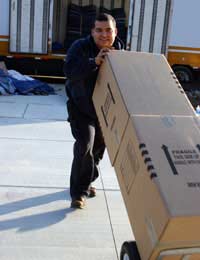
If you lift a heavy object carelessly you can end up pulling muscles or even worse, suffer long-term damage to your back or upper limbs advises Susan Hunt MA of Workplace Safety Advice
So it’s vital that if your job involves lifting, you know how to do it properly. Many employers have short training sessions for this but if not, they should at least be able to give you a leaflet with the main rules for manual handling.
Manual handling can be described as lowering, lifting, pulling, pushing, holding, restraining, carrying, throwing or handling.
75% of injuries caused by manual lifting could be prevented. In the food and drinks industry, manual handling and lifting causes 30% of all acute injuries.
There are general guidelines – or maximum weights – for men and women. If applying these, no man should attempt to lift anything heavier than 25kg and a woman’s maximum limit is 16kg.
But it’s important to take into account other factors which can change the maximum safe weight – such as how high an object will need to be lifted.
If lifting above shoulder height (stocking high shelves for example) men should not lift items heavier than 10kg and women, 7kg – but this maximum weight drops yet again for objects that need to be held away from the body – 5kg for men and 3kg for women.
Employers should carry out risk assessments for all lifting since the safe limit depends on so many variables such as the individual involved, the height that you will be lifting and the distance you will be required to carry the object.
Never assume that because a larger workmate can lift an object without injury that it is a safe weight for you to attempt. Everyone is a different size and we all differ in body strength.
When You Should Take Extra Care:
Stacking items above shoulder height
Carrying items up or down stairs
Carrying items for long distances
Lifting in a small work space – this could mean you have to twist or stoop
Things to Check:
Is the weight of the item within your physical capability?
Have you been given reasonable rest periods between manual lifting tasks?
Is there adequate space to lift safely?
Is lifting fairly shared between employees?
If you believe you are risking injury through manual lifting, ask your employer to undertake a Risk Assessment. It usually takes only a few minutes but it can reduce the chances of injury. (If your employer does not seem concerned about the issue, you could point out that all employers have responsibilities to their workers under manual handling regulations introduced in 1992.)
Finally, if you do suffer an injury or feel any pain while lifting or handling an object, stop immediately and speak to your employer. Make sure that the incident is recorded because it could be some hours later before you realize the true extent of the damage.


