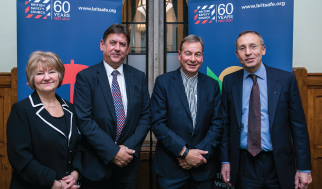
At a reception in Parliament, attended by MPs and peers from across the political spectrum, the British Safety Council launched its new manifesto, Combating risk in the digital age. Protecting people in the economy of the future that will set the direction for its activities in the future.
This year, the British Safety Council has been celebrating its 60th anniversary with a variety of initiatives, films and publications, which reflect its proud history of campaigning for the protection of people and the environment. However, over these 60 years, the environment in which the charity has worked and campaigned has significantly changed.
Until a few decades ago, Britain was an industrial economy and many people were engaged in heavy, manual work. Thousands of people were killed or suffered serious injuries at work, and the focus of the British Safety Council’s efforts were safety issues. Now, Britain is a professional and service-based economy in which workers face different demands and risks. As the number of accidents has decreased, there has been an increasing awareness of health issues and their long-term implications. Today, a highly skilled and knowledgeable workforce is at the heart of the economy. Many people can operate from anywhere with an internet connection and the gig economy is changing the nature of employment relationships.
“These are challenging times for businesses in the UK, and the British Safety Council is committed to leading the way in positioning safety, wellbeing and sustainability at the very heart of all our futures,” said Lynda Armstrong, Chair of the British Safety Council, launching its new manifesto.
Andy Slaughter, MP for Hammersmith, who worked as a press officer for the British Safety Council in 1982, said that the work of the British Safety Council “could not be more difficult and more important than it is today.” Referring to recent government policies such as cuts to legal aid, he said: “I’m afraid the zeitgeist is very much against [health and safety], and the nonsense we hear about ‘health and safety gone mad’. It’s a shame that since the halcyon days of the Health and Safety at Work Act and that revolution in the right direction on health and safety in this country, that we have gone some way backwards.
“But that is what the British Safety Council does best; it is not just a professional organisation, it’s a campaigning organisation. It’s voice is always heard and it’s always on the right side.”
Martin Temple, chair of the Health and Safety Executive, said: “The pace of change is getting quicker and the nature of work is changing faster. We’re now seeing reports that 65% of children entering primary school today will end up working in jobs that do not yet exist.”
The HSE will focus on three health priorities: targeting work-related stress, musculoskeletal disorders and occupational lung disease. The statistics are compelling: in the UK, 12,000workers die from lung disease every year. Nine million working days are lost due to musculoskeletal disorders and 12 million working days are lost due to stress.
“Let’s not kid ourselves that this is all going to be a stroll in the park. We know it’s going to be difficult. But we also know that now is the time to push for improvement,” he concluded.