

Bayer’s business division Crop Science is working on new ways of making the application of crop protection products even safer, in order to minimize risks and optimize impact.
Crop protection products must be applied in a way that ensures the safety of farm workers, consumers and the environment. And with innovative technologies such as new sprayers and a kind of vacuum cleaner for sowing equipment, Bayer is endeavouring to do precisely that.
“We farmers have to do right by the environment and the people. That means we need to apply crop protection products as carefully as possible,” says Stephan Muenks, a farmer from Meerbusch, close to Düsseldorf.
Muenks is putting his faith in the efforts of Reinhard Friessleben, Head of Application Technology at Crop Science. Friessleben works to optimize the application of crop protection products without limiting their effectiveness. The various technologies his team has developed are as different as the crops themselves.
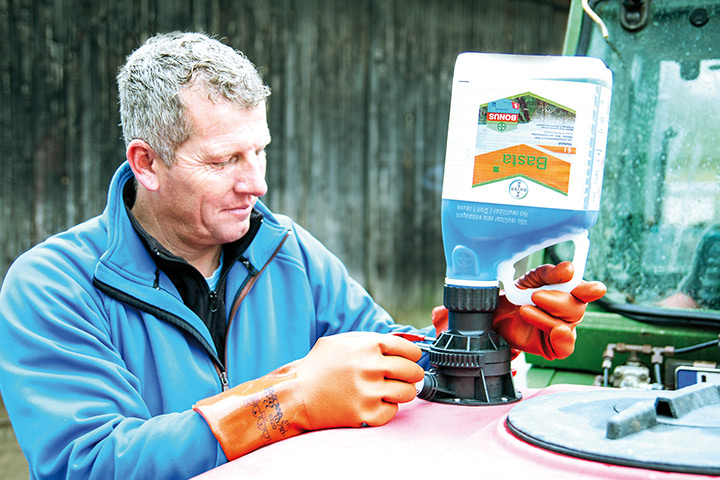
Bayer’s easyFlow technology is designed to ensure a safe, flush connection between tank and canister when the tanks are being filled with liquid product. “That stops any of it from being spilled,” says Friessleben.
Bayer developed the easyFlow adapter in collaboration with nozzle specialist agrotop. It is made up of two elements – the tank adapter and the canister adapter – that fit together like a key in a lock, allowing the liquid to be transferred without contamination and at the right dosage. This stops drips from polluting the soil underneath and from getting into neighboring waterways and wastewater systems. Farmworkers, too, are protected, as they do not come into contact with the chemical substances.
Because the right crop protection needs the right appliance, Bayer is working on other agri-business innovations, too. It wants to get the use of Dropleg sprayers established on canola fields.
Dropleg sprayers have much lower nozzles that deliver crop protection products underneath the crop canopy instead of from above. “That reduces spray drift and avoids crop protection products getting on the flowers,” explains Friessleben. “It protects bees and other pollinators.” The trials of the Dropleg sprayers are almost complete, and results have been positive.
Improving seed drills could help, too. Modern vacuum seed drills suck the seeds onto a sowing disk in a process that can release harmful dust into the environment. “Only a small proportion of that dust is chemical dust,” says Friessleben, “but that’s precisely what we’re hoping to eliminate.”
The experts at Bayer are working on SweepAir, an innovative air-cleaning technology for sowing equipment. It collects the dust released during planting like a vacuum cleaner. The air is drawn into the cyclone, where centrifugal forces separate the dust, which sinks to the bottom of the cyclone and is expelled, allowing it to then be buried in the ground together with the seeds. The filtered air is released close to the ground.
“We must ensure that crop protection products end up only where they are needed,” said Friessleben.


